It started each Thursday evening with empty tables, but it didn’t stay that way for long. A drawing becomes a game. A piece of clay becomes a character. Light and shadow turn into stories and simple materials become whole new worlds. Ideas are tried, changed, played with and taken somewhere nobody quite expected.
For five weeks this summer, The Studio became a place for young people aged 12–17 to experiment, develop ideas, work alongside artists and explore where their creativity might take them.
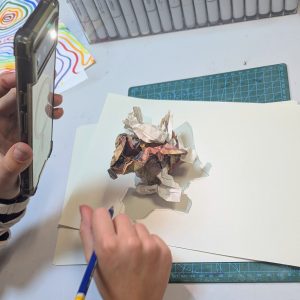
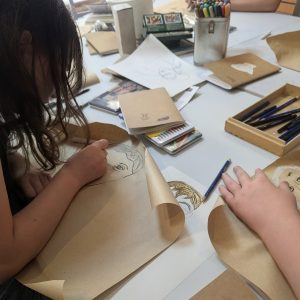
We took over The Community Space in Spring Gardens each Thursday evening over a five-week pilot to play with drawing, light and shadow, clay, small-world building, storytelling and different ways of making.
The idea was simple: give young people a starting point, interesting things to explore and the freedom to decide what happened next. There was nothing they had to create and no pressure to make something ‘good’ – just space to play, experiment and find their own way of doing things.
And over those five weeks, we began to notice some small but rather lovely shifts.
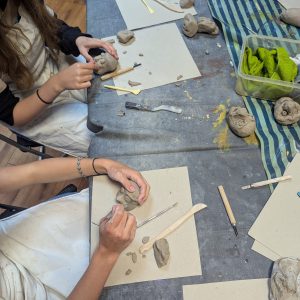
The freedom to freestyle
One of the things we noticed very quickly was just how important that freedom became.
“There weren’t really any rules,” one young person told us after the first week.
By week two, we heard: “You get a set task and then you can do whatever you want with it.”
And by the final session: “I could do my own way of doing things… I could just freestyle it.”
There were starting points, materials to explore and artists around to offer ideas and encouragement, but there wasn’t a ‘right’ way or one thing everyone was supposed to produce.
That gave people permission to experiment, to change their minds. To make something intricate or keep it simple. To try something that might not work. Or to make the worst drawing they possibly could, just because it was funny.
Nobody needed to overthink it, and gradually, we watched the tables fill up.
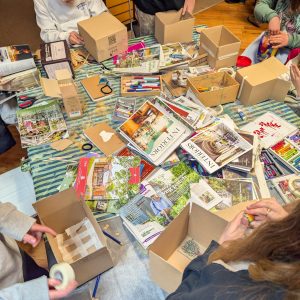
It’s the making that matters
We live in a world surrounded by finished things – the perfect drawing, the polished photograph, the finished project.
The Studio deliberately made space for everything that happens before that. The playing, the trying, the bit that goes wrong and the bit that accidentally becomes something better.
When we asked the young people what they’d enjoyed, they didn’t focus much on having something impressive to show at the end, they talked about the doing.
“I thought the clay was the funnest part.”
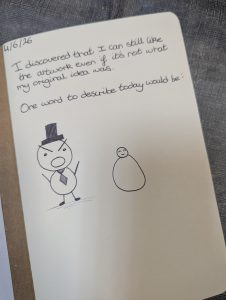
“Designing my own stuff.”
“I stayed on there the longest because I just wanted to carry my drawing on.”
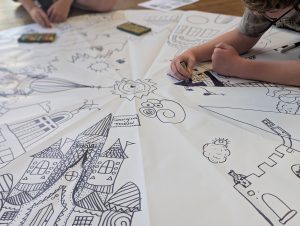
Making together was an important part of that too. Some activities invited everyone to bring their own ideas to something shared, finding ways for individual contributions to meet, overlap and occasionally head off in unexpected directions.
“Everybody’s pictures just linked together in some way,” one said.
Another described it rather perfectly: “You could just kind of do your own thing, but it was kind of a group thing at the same time.”
And collaboration, like creativity, doesn’t always behave itself.
“I enjoyed doing group work to create a better project… I think it’s funny how that always goes wrong.”
Messy, collaborative and joyful – we rather like it that way!
Finding your own way to make
Something else began to change as the weeks went on. At first, we heard lots about the activities themselves. Young people told us what they’d enjoyed doing and which materials they’d liked.
Gradually, they started talking more about how they liked to create.
“I really just like the shadow puppets.”
“I’d like to use materials other than pens, like oil pastels and watercolours.”
“You can be as intricate as you want or as simple as you want, but they still give a character.”
Clay, drawing, shadow puppets, watercolours, building worlds, working together, working alone – there wasn’t one version of being creative that everyone had to fit into.
Instead, we began to see young people making choices, following their own interests and becoming more confident in saying: this is how I like to make.
“I want this to last forever”
By our final Thursday together, something had shifted. The conversations weren’t only about clay, drawings or which activity had been the most fun. Young people were talking about having the freedom to do things in their own way, creating alongside other people and, importantly, wanting that experience to continue.
Then came one comment that has stayed with us: “I want this to last forever.”
Five weeks isn’t a very long time. But it was long enough to see what can begin to grow when young people are given time, space, materials and encouragement – and the freedom to decide where their creativity takes them.
They brought the curiosity, ideas, playfulness and imagination. We gave those things somewhere to grow.
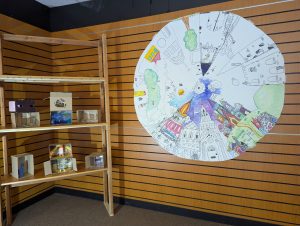
What began as the freedom to have a go became something more – young people making their own choices, discovering what interested them, creating alongside others and growing in confidence in their own way of making.
Watching the young people laugh, experiment, grow in confidence and make the space their own has been a real privilege.
Our next generation of makers and creative thinkers need spaces that feel like theirs. Places where they can play, experiment and make mistakes; where their ideas are listened to, and where creativity doesn’t have to be perfect or even lead anywhere in particular to matter.
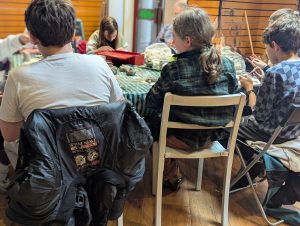
This project was supported by The Arts Society